Archive for the ‘Science’ Category

See an updated version of this post on The Leaf Online, Cannabinoid Profile – CBGa!

Formula: C22H32O4
Molecular Mass: 360.48708 g/mol
Decarboxylation Point: ????

Boiling Point: ????

LD50 (Lethal Dose): Currently Unknown, likely similar to CBG, 300mg/kg for mice  (Compare to Nicotine: for mice – 3mg/kg for humans – 40–60 mg/kg),

Cannabigerolic acid (CBGa) is formed when geranyl pyrophosphate combines with olivetolic acid within the cannabis plant. It is thanks to CBGa that all other medicinal effects of cannabis are possible. Cannabigerolic acid (CBGa) can be thought of as the stem cell cannabinoid, which becomes THCa/THC, CBDa/CBD, CBCa/CBC, and CBG. It does this through different types of biosynthesis, where chemicals combine to form new compounds, examples being the  THC biosynthase and the CBD biosynthase. During these different chemical processes the acid grou Hemp species of cannabis have higher amounts of CBG due to a recessive trait, which may imply higher amounts of CBGa present in those strains as well.
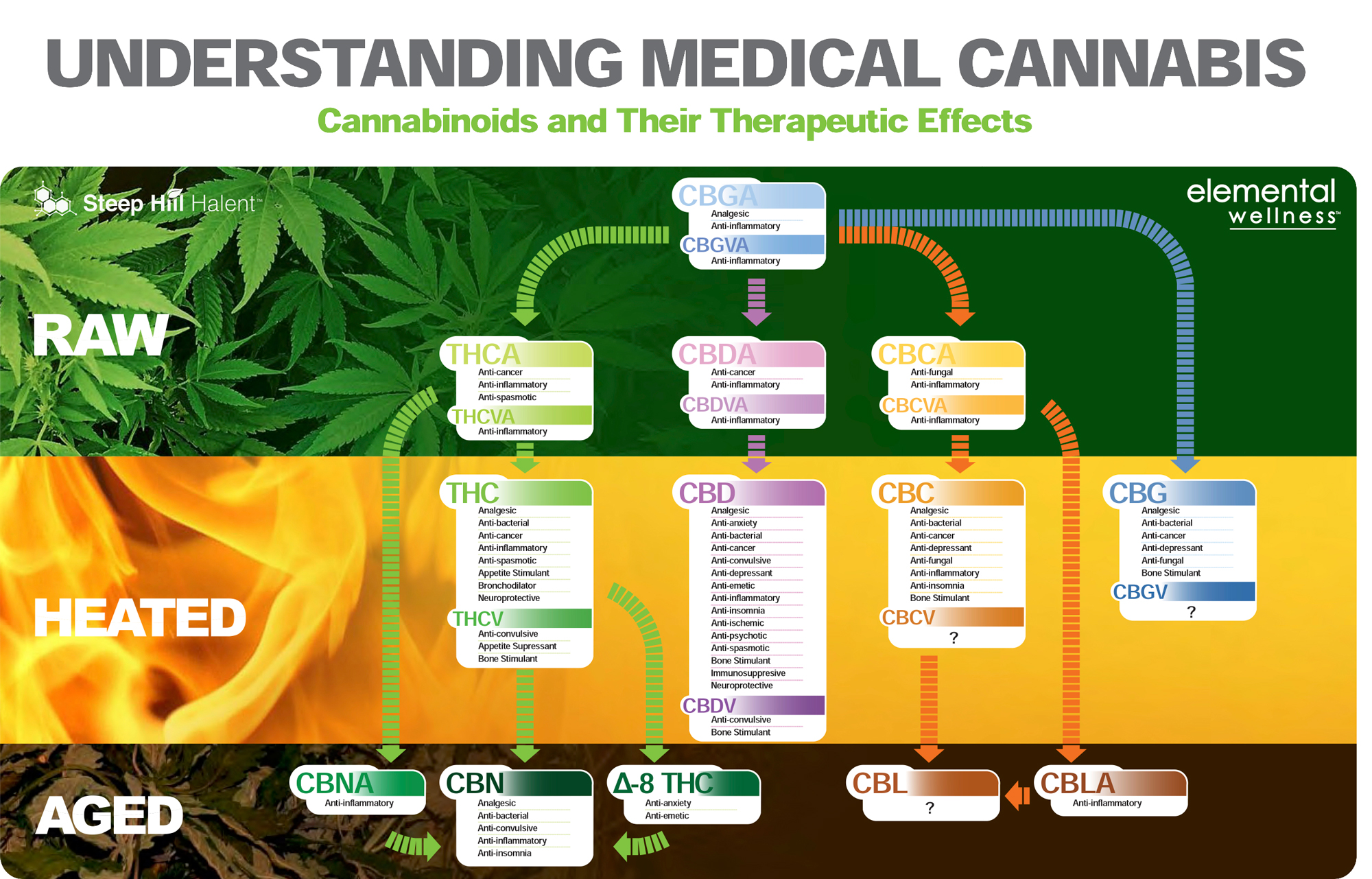
Image Courtesy of Steephill/Halent Labs and Elemental Wellness

Image Courtesy of Steephill/Halent Labs and Elemental Wellness

Therapeutic Uses

Analgesic – Relieves pain.

Antibacterial – Slows bacterial growth.

Anti-inflammatory – Reduces inflammation systemically.

Anti-Proliferative – Inhibits cancer cell growth through apoptosis.


Halent 2011 - Cannabinoid and Terpenoid Chart


Currently Being Studied For

Cannabinoid Biosynthase: Nearly all current research on CBGa focuses solely on its role in the biosynthesis of other cannabinoids. Virtually no money is going to study its analgesic, antibacterial, anti-inflammatory, and anti-proliferative properties.

We learned in 2005 that the enzyme controlling the conversion of CBGa into THCa and further THC is held within the trichomes of the plant. This makes sense, as the trichomes have long been known to be the home of THC. Sirikantaramas did a follow up study on his 2005 research which showed they could grow THCa in a laboratory using a yeast culture as a host. If you want to know more about the THCa synthase, which is the first biosynthase to see any major study, you can look at this 2009 literature review profiling it. It wasn’t until 2014 that any of this research turned back to focus on CBGa again, when Alaoui et Al (2014) identified how and where CBGa binding happened, then explored how it was converted into THCa. Their research could be key to better understanding how THCa production happens and thus how much THCa will be resulting in the plant material.

Cancer: While there are no current studies being done on CBGa for it’s abilities to help with cancer it has been shown to be an anti-proliferative just like CBG, THC, and CBD. CBGa encourages apoptosis, which is programmed cell death. Defective apoptosis is believed to be a major reason for the formation and progression of cancer, one obvious solution to a person having depressed levels of apoptosis is to stimulate that bodily response. Cannabinoids appear to stimulate apoptosis in previously unknown ways posing a novel way to mitigate and potentially cure cancer. While this much is known about CBGa more research should be done.

*Note: Decarboyxlation – A chemical reaction that removes a carboxyl group and releases  CO2, often triggered by heat.

See an updated version of this post on The Leaf Online, Cannabinoid Profile – CBDa!

Formula: C22H30O4
Molecular Mass: 358.2144 g/mol
Decarboxylation Point: 120+ °C (248 °F)

Boiling Point: ????

LD50 (Lethal Dose): 5,000mg/kg for rats, Inhalation TCLO (human): 15,000 mg/m3 mg/kg (Compare to Nicotine: for mice – 3mg/kg for humans – 40–60 mg/kg),

Cannabidiolic Acid (CBDa) is one of the four possible outcomes of Cannabigerolic acid (CBGa) being processed into cannabigerol (CBG), Cannabichromic acid (CBCa), Tetrahydrocannabibolic acid (THCa), and CBDa. CBGa is processed into other cannabinoids by synthase enzymes, the CBDa synthase was first purified and isolated in 1996. Coincidentally, this was the same year California passed Prop 215 and became the first medical cannabis state.

Until recently, CBDa was thought to be a minor cannabinoid and only be a small part of the overall cannabinoid profile. Higher amounts have been seen in ruderalis strains and recent hybrids like Cannatonic C-6 and ACDC have elevated levels of CBDa, potentially more than THCa. Just like THCa, when heated up CBDa becomes CBD. Like CBD, CBDa is not psychoactive. While there hasn’t been much research done on CBDa yet, the research that has been done is quite promising. It appears to have anti-emetic effects as well as anti-proliferative effects, making it ideal for fighting cancer.It also has been shown to be an anti-inflammatory and to possess anti-bacterial properties.

Therapeutic Uses

Antibacterial – Slows bacterial growth.

Anti-Emetic – Reduces vomiting and nausea.

Anti-inflammatory – Reduces inflammation systemically.

Anti-Proliferative – Inhibits cancer cell growth.


Halent 2011 - Cannabinoid and Terpenoid Chart

Currently Being Studied For

Anti-Bacterial: Leizer et al (2000) mention a strong correlation between the levels of CBDa in a plant and the CBD levels of the plant after synthase. They also mention that more CBDa present will mean greater antimicrobial potency in the resutling CBD. They do not explain the mechanisms at work.

Anti-Emetic: A 2013 study shows that CBDa reduces vomiting and nausea by increasing activity at the 5-HT1A receptor. This means that CBDa can be used as a non-psychoactive alternative to THC to prevent vomiting and nausea. This isn’t the first study to show this, a 2011 study found that CBDa functioned as an anti-emetic but did not pin the relation to the 5-HT1A receptor. More research should be done to properly explore this exciting new medicinal use for CBDa.

Anticipatory Nausea: Anticipatory Nausea (AN) is a condition where someone vomits due to neutral stimuli, before they are actually nauseous. AN is very common in patients receiving chemotherapy, roughly 29% will develop it. AN appears to be the result of classical conditioning; given enough exposures to neutral stimuli, like the smells of the chemotherapy room, a susceptible person will begin to vomit before even receiving treatment. In a 2014 study, CBDa was shown to be a very effective treatment for sufferers of AN. In 2013, the same group of researchers found that  CBDa was an effective treatment for acute nausea in chemotherapy patients.

Cancer: In 2012 CBDa joined THC, CBD, and numerous other cannabinoids that are anti-proliferatives. These cannabinoids control the growth of cancerous tumors. Takeda et al (2012) found that CBDa could inhibit the migration of human breast cancer cells. This government funded study recognized CBDa’s potential to mitigate the effects of cancer, even aggressive ones.”The data presented in this report suggest for the first time that [a] component in the cannabis plant, CBDA offers potential therapeutic modality in the abrogation of cancer cell migration, including aggressive breast cancers.”

*Note: Decarboyxlation – A chemical reaction that removes a carboxyl group and releases  CO2, often triggered by heat.

Hey readers,

While I am working on some more meaningful posts to get on here, some Burning Man oriented ones to get people ready for the impending Burn, I wanted to add a short personal post.

As most of you are not aware I was just given a paid position as a writer for The Leaf Online, a very excellent online cannabis newspaper. You can find all my posts here, including many of my cannabinoid profiles from this blog. I am trying to find a way to cross post all my Leaf articles to this blog, but haven’t quite figured out a good way yet. Until then you’ll all need to go over there to read my cannabis posts (though some will still end up here, such as my cannabinoid profile on CBN).

I’m ever grateful for the opportunity and support The Leaf has given me, but never fear, Well Suited For Life will not be forgotten either. I’d love it if you read over and share around my Leaf posts, especially this one about the much-discussed cannabis strain Charlotte’s Web.

See an updated version of this post on The Leaf Online,Cannabinoid Profile – CBN!

Formula: C21H26O2
Molecular Mass: 310.4319 g/mol
Decarboxylation Point: 77 °C (171 °F)

Boiling Point: 185 °C (365 °F)

LD50 (Lethal Dose): 13500mg/kg for mice (Compare to Nicotine: for mice – 3mg/kg for humans – 40–60 mg/kg)

Cannabinol (CBN) is what tetrahydrocannabinol (THC) will break down into over time due to exposure to oxygen and heat. CBN is a mild psychoactive, much less intense than when it was THC. CBN is the strongest cannabinoid identified for promoting sleep, this makes cannabis rich in CBN an ideal treatment for insomnia. Indica strains appear to have more CBN than sativa strains, this would explain the commonly held belief that indicas make you sleepy and give you a body high. CBN is a CB2 and CB1 receptor agonist and may inhibit immune cell functionality.


Therapeutic Uses

Analgesic – Relieves pain.

Antibacterial – Slows bacterial growth.

Anti-Emetic – Reduces vomiting and nausea.

Anti-Epileptic – Reduces seizures and convulsions.

Anti-inflammatory – Reduces inflammation systemically.

Anti-Insomnia – Aids with sleep.

Anti-Proliferative – Inhibits cancer cell growth.

Appetite Stimulant – CBN appears to be a mild appetite stimulant.

Bone Stimulant – Promotes bone growth by stimulating osteocytes.


Halent 2011 - Cannabinoid and Terpenoid Chart


Currently Being Studied For

Analgesic: Both THC and CBN have been identified as pain killers, though THC is far more powerful. A 2002 study identified that both THC and CBN cause a release of certain gene-related peptides from sensory nerves and they are the only identified cannabinoids to use this mechanism.

Appetite Stimulant: Everyone knows that THC stimulates the appetite, giving users the  ‘munchies’ that many people describe. It was only in 2012 that it was discovered that CBN also stimulates the appetite, though it appears to be not as strong as THC.

Cancer: A 2006 study revealed that CBN joins THC and numerous other cannabinoids in having the ability to control the growth of cancer cells. CBN specifically was found to control a type of lung tumor known as a Lewis carcinoma.

*Note: Decarboyxlation – A chemical reaction that removes a carboxyl group and releases  CO2, often triggered by heat or exposure to sunlight.

See an updated version of this post on The Leaf Online,Cannabinoid Profile – THCa!

Formula: C22H30O4
Molecular Mass: 358.4733 g/mol
Decarboxylation Point: ???

Boiling Point: 105 °C (220 °F)

LD50 (Lethal Dose): 5628mg/kg for rats (Compare to Nicotine: for mice – 3mg/kg for humans – 40–60 mg/kg)


Found in the trichomes, Tetrahydrocannabinolic acid (THCa) is the acidic precursor to THC, which actually exists in only minute quantities in the living plant. In living cannabis, THCa is the most abundant cannabinoid and terpenoid, potentially reaching over 30% of the dry weigh of the cannabis. Once the plant is harvested it begins a clock where, over time, the THCa begins to be converted into THC, a process quickened by exposure to heat and sunlight. One main reason cannabis is cured is to convert the THCa into THC, as well as drying it out to make it easier to burn, thus releasing the remaining THCa as THC. Knowing about decarboxylating cannabis is crucial in making edibles, where one pre-cooks the bud  before making it into butter to raise the potency by converting THCa into THC.

Like all cannabinoids that exist in the living cannabis plant, THCa is non-psychoactive, though it still stimulates the appetite like THC. It also is a powerful anti-inflammatory, helps fight cancer and other tumors, aids with sleep, and more. Also like THC, an oral test has already been developed to detect THCa. While some sources show THCa to be a stable compound, Aphios research chemicals claims that it is very unstable and will breakdown into THC within weeks. It may have to do with the preparation of synthesized THCa used in their laboratory versus an active live-plant based THCa, but without further research the stability of THCa and how quickly it converts to THC is unknown.


Therapeutic Uses

Analgesic – Relieves pain.

Anti-Emetic – Reduces vomiting and nausea.

Anti-Inflammatory – Reduces inflammation.

Anti-Insomnia – Aids with sleep.

Anti-Proliferative – Inhibits cancer cell growth.

Antispasmodic –  Suppresses muscle spasms.

Modulates Immune System – THCa has been shown to both improve and potentially suppress the immune system functions.

Neuroprotective – Slows damage to the nervous system and brain.


Halent 2011 - Cannabinoid and Terpenoid Chart

Currently Being Studied For

Anti-Emetic: THC has long been recognized as a valuable tool in combating nausea, but research done in 2013 found that THCa may be even more effective at preventing nausea and vomiting than THC. This means that patients suffering from nausea who do not want the psychoactive effects of THC should consider THCa.

Cancer: Many sources online claim that THCa helps fight cancer, but few studies have been done examining the cancer-fighting properties of this non-psychoactive cannabinoid. This 2011 study hints at the anti-tumor properties of THCa but its main focus was on the interaction of various cannabinoids and the TRP protein receptor channel. A 2013 study looking at prostate cancer also found THCa to be effective but did not elaborate on the mechanisms used or recommend further study.

Lupus: While no formalized studies are being done on THCa and Lupus, Dr. William Courtney and his wife Kristen have anecdotally demonstrated that fresh juiced cannabis high in THCa can control Lupus. As Kristen is still alive and managing her Lupus this study is ongoing, and still a success.

Neuroprotective: A 2012 study done on cell cultures shows that THCa may be a mild neuroprotective compounds for certain classes of brain cells, preventing unwanted cell death. These effects do not seem as notable as the neuroprotective qualities of THC and CBD but they are certainly worth more research.

The THCa/CBGa Process: Cannabigerolic acid (CBGa), CBG, THCa, THC, CBD, and CBC are all related compounds formed from the same chemical processes. CBGa and THCa are the originator compounds that appear to morph into the others. This linkage was explored in this 2012 study but needs further research to fully understand the mechanisms it works through.

*Note: Decarboyxlation – A chemical reaction that removes a carboxyl group and releases  CO2, often triggered by heat or exposure to sunlight.

See an updated version of this post on The Leaf Online,Cannabinoid Profile – CBC!

Cannabichromene

Formula: C21H30O(Same as CBD but configured differently)

Molecular Mass: 314.2246 g/mol

Decarboxylation Point: ???

Boiling Point: 220°C (428°F)

LD50 (Lethal Dose): 270mg/kg for monkeys (Compare to Nicotine: for mice – 3mg/kg for humans – 40–60 mg/kg)


Cannabichromene is a little understood non-psychoactive cannabinoid that has recently been seeing a lot more research. Like THC and CBD, CBC is an end product of CBG being processed into CBGa, and then into new cannabinoids. As a result, CBC has the same chemical formula and weight as CBD and THC but they all have a different configuration of the molecules. The lack of research hasn’t stopped it from being patented for various uses, recognizing its wide range of medical uses. CBC is an analgesic and anti-inflammatory, like THC and CBD though less potent. CBC is anti bacterial and CBCa has been shown to be an antifungal agent. Like CBD, cannabichomene is both a bone stimulant and neurogenic compound, helping grow both body and mind. Perhaps its most important use is as an anti-proliferative, slowing tumor growth and combating cancer, just like CBD and THC. CBC has also been shown to be ten time as powerful as CBD at reducing anxiety and stress.

Therapeutic Uses

Analgesic – Relieves pain.

Antidepressant – Relieves symptoms of depression.

Antifungal  Inhibits the growth of fungus.

Anxiolitic – Relieves anxiety.

Anti-inflammatory – Reduces inflammation systemically.

Anti-Proliferative – Inhibits cancer cell growth.

Bone Stimulant – Promotes bone growth.

Neurogenesis – Promotes the growth of new brain cells.


Halent 2011 - Cannabinoid and Terpenoid Chart

Currently Being Studied For

Analgesic: While only a study on rats, CBC was been shown to have great promise as an analgesic painkiller, perhaps as good as CBD.

Antidepressant: In this 2010 study, both THC and CBC were shown to display significant antidepressant qualities and “contribute to the overall mood-elevating properties of cannabis.”

Anti-Inflammatory: In two other recent studies on rats CBC was shown to be a powerful anti-inflammatory. Interestingly it was found that the mechanism of action did not involve CB1, CB2, or the TRPA1 receptors, like with THC and CBD; this is certainly worth more research as it could imply another type of receptor site is present.

Neurogenesis: study done last year confirms that CBC stimulates bone growth. As neurogenic compounds are very rare this makes CBC a very important cannabinoid worth significant research. This could make CBC useful in treating the Alzheimer and other neurodegenerative conditions, but that will need more research.


References:

  1. Steep Hill Lab, Cannabinoid and Terpenoid Reference Guide; http://steephilllab.com/resources/cannabinoid-and-terpenoid-reference-guide/
  2. Skunk Pharm Research, Cannabinoid and Terpene Info; http://skunkpharmresearch.com/cannabinoid-info/
  3. SC Labs, Meet the Cannabinoids; http://www.scanalytical.com/the-cannabinoids.html

*Note: Decarboyxlation – A chemical reaction that removes a carboxyl group and releases  CO2, often triggered by heat.

Hey readers sorry for my extended hiatus. I had to have surgery on my broken wrist, which failed to heal right in the cast, which took some time. Then I transferred jobs to a new location, closer to home. But mostly I have been busy writing in my novel and building my own computer. This is my first time ever building a computer myself and it was a real learning experience, one I am ever grateful to my friends for. It is only thanks to the good graces of my housemate that I figured it all out and put it all together.

If you are like most people, including me, the idea of building your own computer seems daunting. For me the biggest issue was I had no clue what hardware actually was required for a computer, and as a kicker the hardware has changed since I last fuxed with upgrading hardware in my old desktop 8 years ago. You are looking at a man who has been using the same laptop with Windows Vista since before Obama was president. This upgrade has been long overdue.

So what are the core components of a computer that you will need for it to run? There are between eight to ten parts, depending on what you view as necessary.

1. Case – You need something to put all that expensive hardware in.

2. Motherboard – This is what everything in the computer attaches to, it IS the computer, for lack of better words.

3. Power Supply – This part converts the power from your wall socket into power usable by your computer.

4. Central processing unit (CPU) – This is the heart and brain of your computer.

5. Random-access memory (RAM) – RAM is short term memory used for processes, as opposed to longterm memory used for storage.

6. Drives – There are two main categories of drives, Disc Drives and Storage Drives. Disc drives hold CDs, DVDs, Blurays and other media to access the data on those discs. Storage drives provide longterm data storage to hold files on your computer.

7. Graphics Card – While you do not NEED a graphics card if you want to play any sort of video games or use adobe photoshop, or really do much more than word processing and surf the web then you want a graphics card. Motherboards come with a built in graphics card but they pale in the comparison to having an add-on graphics card.

8. Cooling Device – Computers get very hot and they do not like that. Heat will damage your parts and you should strive to keep your PC as cool as possible.

9. PERIPHERALS | Monitor, Mouse, Keyboard – The monitor is what you are currently using to read this text (textception…) I typed this on a keyboard and clicked post with my mouse. None of this would have been possible without peripherals, which is anything that lets you interact with the computer. It is possible to have a computer that runs without any of this, like a server.

10. OPTIONAL | Sound cards, wireless cards, more fans – While you can get a sound card to attach to your motherboard, like a video card, they are utterly superlative and not worth the money. Wireless cards are nice but I prefer to be hardwired into my Internet to avoid disconnects while gaming. I’m not using either of these parts in my build. I am waiting for 3 more LED blue glowing case fans while will both keep my computer cool and keep my computer cool.


Now, that doesn’t look so daunting does it? Just nine things really, and some are obvious things like a case, mouse, monitor, etc. You may even have some parts you can reuse from your old computer (monitors, extra hard drives for storage). The next major question is how do I pick the right parts? I used two main websites to figure this out, reddit/buildapc and Tom’s Hardware. These same sites conveniently have links to where you can buy parts. Once I found these sites it became a matter of figuring out my budget and the best configuration of parts I could afford.

Once all your parts arrive it is time to build that computer. I advise buying all your parts on the same day so they arrive around the same time, this will maximize the amount of time you have to trouble shoot and possibly return parts. I had to wait on a second motherboard because I bought an AMD motherboard for my Intel CPU, a totally avoidable newbie mistake that you can prevent by making sure your motherboard is compatible with your CPU. Most returns will be with a refund unless you manage to damage the part; I got a full refund and didn’t even have to pay to ship it back.

Before you build your computer, perhaps even before buying your parts I would recommend watching two videos produced by Newegg. These videos on how to choose your parts and then build your computer are very informative and accessible, as long as you can get past the smug looking tech douchebag with a soul patch. There is a third part on how to install Windows but I am doing my best to remain neutral regarding the OS since there are many valid options. Sure there is Windows and Mac, but there is also Ubuntu, Linux, and Linux’s grandaddy Unix. While Windows kind of dominates the gaming market you can always just run a Windows partition on an Ubuntu or Linux machine.

And that’s how you build a computer.

Hey readers, I’ve got another great cannabis themed blog for you today discussing the various types of cannabis concentrates out there on the market. This isn’t one of my usual cannabinoid profiles but it is just as necessary. Doing a quick Google search I can tell there is a ton of misinformation out there  about concentrates and I hope this post can help clear things up.

A couple notes before we start, pre-empting some questions. While every purity rating given is in THC ever type of concentrate listed here can be made from CBD-rich cannabis making the resultant concentrate also CBD-rich. A method of vaporizing cannabis will be discussed called dabbing, this method is usually done with only super melt hashes but in actuality you can dab anything over 55% THC. Dabbing involves super heating a titanium “nail” with a small blow torch and dropping a hash of sufficient purity onto it, which causes the hash to vaporize.

The Concentrates

Kief.

Kief – Kief is the term for the trichomes of the cannabis plant once they have been removed from the plant. Usually kief is obtained during trimming when it falls off the plant and can be gathered with a mesh screen. Kief can also be made with a machine resulting in exponentially more potent kief, more accurately labelled a kief-melt (a play on full melt hash). Kief generally is between 10-25% THC but at Harborside we’ve had kief test upwards of 55% THC, which makes it potent enough to be dabbed. Kief is always dry sieved cannabis, without any water processing.

Hash.

Hash – Hash can be made through many different methods, the simplest being pressing kief and resin together with ones fingers to make so-called “finger hash,” perhaps the oldest form of concentrated cannabis known. Hash tests a little more potent than most kiefs but not quite as strong as bubble hash, usually between 15-35% THC. Aside from the method of creation, hash is distinguished from bubble hash by the fact that it burns rather than bubbling up.

Bubble Hash.

Bubble Hash – Bubble hash is a water-based hash that is made using a series of bubble bags filled with freezing cold water and ice cubes. Bubble bags are a series of increasingly finer mesh bags that trichomes pass through creating various qualities of bubble hash in each bag level. The trichomes are dislodged from the plant by being frozen then smashed off by the ice. This type of hash gets its name because it bubbles rather than burning, but it doesn’t melt like a full melt hash. These hashes range in the 20-45% THC range.

Full melt hash. Not always this color but always this consistency.

Full Melt Hash – Full melt hash is the highest quality of bubble hash, it is what you find in the bottom bag that has passed through every purity grade. These hashes while still being cold water derived more resemble the oily super melt concentrates I will discuss below. These hashes get their name because unlike bubble hash they do more than just bubble, they melt fully into a liquid form. These hashes range in purity from around 45-70% THC. Here is one method to make full melt hashes that can test nearly 70% THC, without any sort of a chemical solvent used.

BHO/Super melt, this one looks like melted shatter.


Super Melt Hash – Super melt hashes are not made with bubble bags and usually use some sort of a chemical solvent, though so-called solvent free varieties exist. They are called super melts because they  melti super-fast from a solid form into a vapor form, sublimating without fully being a liquid. This is a result of the purity of the product and method of use, not a result of the chemical solvents. Commonly used solvents are butane, isopropyl alcohol, and CO2. Common slang names are ISO hash, Butane Honey Oil (BHO), shatter, wax, oil, dabs, and numerous more.

These hashes contain between 55% THC on the low end to over 90% THC on the high end, most are between 55-80% THC. While these hashes can be made by anyone in their garage the best ones are coming out of scientific grade laboratories; you won’t find someone making 90% pure hash in their bathroom. The most common method of use is dabbing, effectively freebasing cannabis. Many in the medical community have expressed concerns over people getting over-medicated and more serious health concerns, such as lung collapse, resulting from dabbing.

A Note on Super Melt Hash Legality: IT IS ILLEGAL TO MANUFACTURE ANY CONCENTRATE THAT USES A CHEMICAL SOLVENT. Unfortunately state law on this issue lags behind medical cannabis as a whole and the creation of super melt concentrates is regulated under the same law as meth labs. As you probably know making meth is very illegal, a felony; in the eyes of the law making super melt concentrates is also a felony. Be very careful if you are making BHO or any other concentrate, especially is traveling through local areas that are tough on medical cannabis rights. Individual state laws may be different but this is written with California laws in mind.

To quote directly from California state law: “Section 11379.6(a) states: Except as otherwise provided by law, every person who compounds, converts, produces, derives, processes, or prepares, either directly or indirectly by chemical extraction or independently by means of chemical synthesis, any controlled substance – shall be punished by imprisonment in the state prison for three, five, or seven years and by a fine up to $50,000

See an updated version of this post on The Leaf Online,Cannabinoid Profile – THCv!

Formula: C21H30O2? (All the information I read online said THCv had the same molecular formula as THC, but it looks like it might be bound in a different configuration.)
Molecular Mass: 314.47g/mol

Decarboxylation Point: ???
Boiling Point: <220°C (428°F)

LD50 (Lethal Dose):  Unknown, likely comparable to THC. (Compare to Nicotine: for mice – 3mg/kg for humans – 40–60 mg/kg)

THCv is a non-psychoactive variant of THC. The other major difference between the two is that instead of stimulating appetite, the famed ‘munchies,’ THCv actually suppresses appetite. For that reason THCv is being heavily researched as a weight loss tool. Like many cannabinoids it is an anti-inflammatory and an analgesic, though less strong than CBD and THC, but using different mechanisms in the body.

Therapeutic Uses

Analgesic – Relieves pain.

Anorectic – Appetite suppressant, promotes weight loss.

Anti-Emetic – Reduces vomiting and nausea.

Anti-Epileptic – Reduces seizures and convulsions.

Anti-Inflammatory – Reduces inflammation systemically.

Bone Stimulant – Promotes bone growth.

Euphoriant – Produces feelings of euphoria, promotes happiness and relaxation.

Currently Being Studied For

Diabetes: A combination CDB/THCv tincture is in a phase 2 clinical trial as a way to mitigate diabetes. GW Pharmaceuticals, a British company, is a world leader in cannabis research. GW is presently examining CBD/THCv’s abilities to ameliorate insulin sensitivity.

Weight Loss: The same mechanisms that allow THCv to combat diabetes combined with THCv’s anorectic properties make it an effective way to combat obesity and control weight gain. GW Pharmaceuticals is also leading this research. GW believes in THCv so much they have even patented its abilities to combat weight gaining and diabetes.

Parkinson’s Disease: THCv is a cannabinoid that has been identified that can aid in Parkinson’s Disease by attenuating the motor inhibition caused by 6-hydroxydopamine. It also has various related mechanisms that assist in treating Parkinson’s.

Anti-Inflammatory: This study was only done on mice but if other studies are any indication of success it should apply similarly to humans, but THCv shows to be an anti-inflammatory. It works through a different mechanism than other anti-inflammatory drugs, THCv inhibits cyclic AMP production by hCB(2) CHO cells, but does not inhibit other affiliated cells. The whole thing seemed to rely on the CB 2 receptors.

http://www.ncbi.nlm.nih.gov/pubmed/15302527

http://www.google.com/patents/EP2356987A1?cl=en

Halent 2011 - Cannabinoid and Terpenoid Chart

References:

  1. Steep Hill Lab, Cannabinoid and Terpenoid Reference Guide; http://steephilllab.com/resources/cannabinoid-and-terpenoid-reference-guide/
  2. Skunk Pharm Research, Cannabinoid and Terpene Info; http://skunkpharmresearch.com/cannabinoid-info/
  3. SC Labs, Meet the Cannabinoids; http://sclabs.com/learn/learn-cannabinoids.html

*Note: Decarboyxlation – A chemical reaction that removes a carboxyl group and releases  CO2, often triggered by heat.

Back from a brief hiatus from blogging to focus on other projects I’m back to fill your inboxes and thought-boxes with new blog updates. Today will just be a brief guide for my fellow Californians on how to conserve water. While this will be a short post it may be one of the most important things I post given that California is in its worse drought in 500 years. If it wasn’t bad enough it not appears to be getting worse. Things are so bad that the Governor and many cities are calling for voluntary rationing. The life or death question is – why the bloody hell hasn’t anyone made rationing mandatory? Hellooooo guys, worst drought ever, what about that isn’t scaring you into imposing mandatory rationing? My current city and hometown of San Francisco leads the state, using 49 gallons per person per day on average  versus 100.

1. If it is yellow leave it mellow, if it is brown flush it down. We probably all heard this as kids from environmentally conscious parents, I know I heard it enough were it became rote. I would imagine that is a result of growing up in California and dealing with near constant droughts all my life. We Californians should be used to drought conditions by now. This is a major one since your average toilet flush uses over 2.5 gallons of water and is flushed over 5 times a day. That’s over 12 gallons a day for most toilets.

2. Shower less. No really, shower less. If you currently shower daily, shower ever other day, if you already shower less often than daily cut back to less. I’m showering twice a week now and no one has said a peep, it’s amazing what deodorant and changing your shirt daily can do. At Burning Man I went a solid ten days without a shower, that is pretty close to my maximum limit in the dusty context of the Playa. No shower for ten days does not mean not bathing, you can do wonders wiping yourself down with baby wipes (even your hair). Showers account for 17% of residential water use. Most showers average 7-10 gallons a minute, but there are ways to reduce that. Think about that next time you extend that morning shower just because it ‘feels nice.’ BTW, despite that ten days of dusty no-showers I still consider myself a clean freak, just less OCD than I used to be.

3. Develop a system for washing dishes. I’m working on implementing a system in my house with a soaking tub to reuse water for soaking and minimize the use of new water for rinsing. Using cast iron is also immensely helpful since you hardly ever use water to clean cast iron.

4. Cook things that use less water. I love making soup, but soup is half water. Now is not the best time to be making soup if you can opt for cooking things that use less water. Rice and pasta are also pretty water intense. You can always use cooked in pasta water as grey-water for watering plants once it has cooled!

5. Use your grey water. Whenever possible find ways to reuse your water. One thing I often do is use the same water to rinse out multiple bottles to put in the recycling. Oh yea, did you know you’re supposed to wash out your recycling and not leave it filled with food remains? Common courtesy folks and it makes the somewhat inefficient recycling process slightly more cost effective. You can use any water without chemicals in it to water plants; I would not recommend using dish water unless you are using a totally biodegradable/organic/all natural soap. The food waste could be an issue, or compost?

6. Set up a rain capture system. There are various ways to do this but most are variants on a barrel design. You can even pull water out of thin air using a fog capture system, something I am considering for my home in San Francisco.

7. Let your lawn die. Just stop watering it, let it go fallow, then plough that crap under and make a garden. If you are going to use water to maintain plants at least make sure they are drought resistant plants or useful things like food-baring plants/herbs.

8. Stop washing your car. I don’t even have a car anymore so I stopped this years ago. Thankfully cleaning a bike is much more water efficient than washing a car too. At the least create a more efficient system to wash your car, efficiency is the name of the game.

9. Gamify saving water, especially with kids. I like to use gamification to turn mundane things into fun games I can play with myself and the world. One game I am big on right now is “how little water can I use today?” For children you can try rewarding them for positive behavior, such as praise for taking a shorter shower or remembering to leave yellow mellow. I leave the games up to the individual as only the individual will know what properly motivates them to right action.

10. Group showers? What happens in San Francisco stays in San Francisco…

[EDIT]11. Transform sewer water into drinking water. Yep, it’s possible and here is the DIY guide on how to make what you need to do it. I’m ready for the apocalypse.