I love hummus. It’s delicious, nutritious, and super easy to make. It’s also 100% vegan if that is something that matters for you. Hummus, like salsa, is a template. You can add whatever you want to spice it up in different ways. I love mine super heavy on garlic and olives with hints of a half dozen other spices. While I did say hummus is easy to make it comes with a major caveat, without a food processor you might as well not even try. I have never tried it without my food processor with success. I once tried in a blender but it was not successful (could have just been the blender though).
I hope you enjoy my first cooking post. These are old photos that I took before a fire trashed my old house and I was forced to move. All future postings will feature my new kitchen which doesn’t have my beer collection in it (yet).
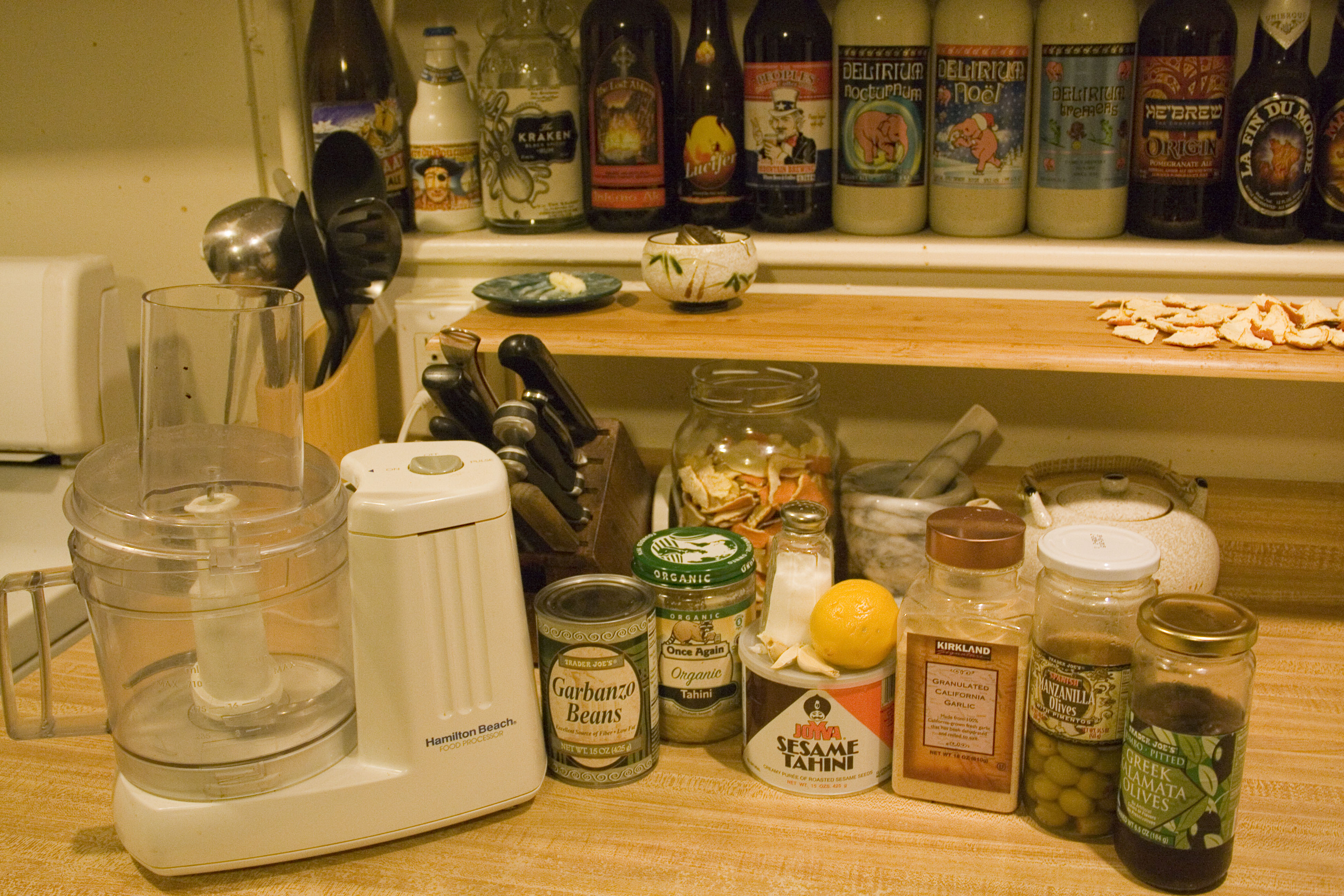
You Will Need: Garbanzo beans, tahini sauce (I used a combo of two tahini’s for this hummus), Salt, Lemon Juice, and Garlic….everything else is optional (yes, even olive oil).
Normally olive oil is viewed as a component part of hummus, I’ve made multiple batches without it and there is virtually no difference. I prefer it with olive oil myself though, mostly for the good saturated fats found in olive oil.
Step One: Pour the garbanzo beans into the food processor, including the liquid the beans were soaking in (whether canned or fresh). Add tahini to taste, I usually add about two heaping tablespoons. Blend until it has a homogeneous consistency.
Step 2: Add your salt, about a teaspoon or so, to taste.
Step 3: Add you lemon juice, make sure to get the seeds out or you will have crunchy hummus. I usually use a full lemon, the citric acid and salt are your only preservatives. Fresh hummus keeps about a week in a fridge, maybe more if you load up on salt/lemon.
Step 4: Add your garlic. I use fresh minced garlic as well as powdered garlic…seriously, I love garlic in a bad way.
Step 5: Now for optional add ins like pine nuts and olives. My hummus usually had both in it as well as a bouquet of spices.
Finished hummus should look something like this, with a nice creamy consistency. Some people like chunky hummus, if you are one of them do the same as above but with less blending (only blend at the very end of the process).
TerminalVelocity (N) – The state of being at ones maximum speed given the physical effects of drag, gravity, and other contextual forces.
It also can be defined to mean the speed at which one is approaching death (Sub-definition: Velocity 3a and Terminal 5).
Today I was riding my bike to Diridon train station in downtown San Jose on my way back home to San Francisco. It was a normal morning like any other, I was stopping for lights and obeying the traffic laws. I was homefree, within two minutes of the train station; truly, the last road I was on before getting there. Today was a day like any other, but then it became a day unlike any I have experienced, a bicyclists worst-case-scenario.
Here is where it all goes wrong. Out from between two parked cars, not even a car length ahead of me, a homeless man strolls out right in front of me. I begin to brake and yell, doing everything I can to avoid him while not swerving into oncoming traffic or the parked cars he jumped out from. As I knew the second I saw him cross my path without even looking I hit him. He went down and I went down with him, even now my right wrist is in a brace and I wait to go in for an X-Ray. I asked him, bluntly, “Did you even look?” My response was a zombified moan, not a moan of pain so much as a moan of “God I am really high and have no clue what happened.” At that he got up and walked off without saying a single intelligible word.
I had to stop and do some road-side repairs but was soon back on my bike and got to my train on time, with minimal injury to myself or my personal effects (my Canon Rebel XT).
I tell this story for pedestrians, drives, and bicyclists alike to all learn from. As a pedestrian, if you are jaywalking into traffic the onus is on you to check and make sure it is safe. As a car or cyclist, you need to be looking out for pedestrians, even if they are not paying any attention at all; but sometimes there is no good option. Would it have been better for me to swerve into oncoming traffic and get killed myself? Our homeless man is very lucky I was only a bike going 20mph, not a car. As I mentioned in a previous post, cars are 4,000 pound death sledges; I would have flattened him had I been in a car, instead we were both able to walk/ride off.
Please, be safe on the roads, no matter what transportation you use. A pedestrian breaking the law in the wrong place at the wrong time is as bad, maybe worse, than a car or a bike. We all only have one life.
As I mentioned in my first post I work at Harborside Health Center, the world’s largest medical cannabis dispensary and one setting a law-abiding example for all other collectives to emulate. We’ve been featured in the Discovery Channel documentary Weed Wars and CNN’s recent show Inside Man. We are also winning a major court battle against the Department of Justice in Federal court with the full support of the city of Oakland. This cannabinoid profile is based off something I prepared for work to help educate our staff, the first of many to come. While my manager only asked me to make one for CBD, as time allows, I plan to cover all major cannabinoids (THC, THCa, THCv, CBG, CBCs, etc). A slight bit of background on myself, though my BA is in political science it would be more accurate to say I went to school for a bachelors in cannabis. I wrote numerous research papers about cannabis while in school, I briefly appeared on CNN discussing why we should legalize it to end the war with Mexico’s cartels, and I was a regional director for Proposition 19 as well as 2012’s failed Regulate Cannabis Like Wine act. That is just the tip of my drug policy activism and merely the cover of my activists resume, but all that is terribly relevant to mention now. Future Cannabinoid Profile posts won’t bother with this introduction, I’ll just jump right into it from now on.
CBD is non-psychoactive and it is a powerful anti-psychotic drug, valuable for sufferers of psychosis or schizophrenia. CBD has been shown to be at least as strong an anti-inflammatory as Ibuprofen and at least as effective as THC for treating pain and managing tumors. CBD has a wide range of therapeutic uses ranging from physical ones like pain relief to mental ones like relief of anxiety and depression. CBD is also neuroprotective and neurogenetic, protecting the brain and promoting the growth of new brain cells. CBD has been shown to be extremely effective in treating seizures.
Due to the fact that it is non-psychoactive and strongly medicinal even in small doses CBD is highly recommended for treatment of children, the elderly, and anyone who wants to remain clear headed yet medicated. CBD appears to change how THC affects the body, making it less psychoactive and more therapeutic; this process is still being actively researched. CBG ,CBD, and the CBC’s all share the same molecular formula but have a different structure.
Therapeutic Uses
Analgesic – Relieves pain.
Antibacterial – Slows bacterial growth.
Anti-Diabetic – CBD is the only cannabinoid identified that helps lower blood sugar levels.
Antidepressant – Relieves symptoms of depression.
Anti-Emetic – Reduces vomiting and nausea.
Anti-Epileptic – Reduces seizures and convulsions.
Anti-Ischemic – CBD is the only cannabinoid identified that reduces the risk of artery blockage.
Antipsioratic – CBD is the only cannabinoid identified to treat psoriasis.
Anti-Proliferative – Inhibits cancer cell growth.
Antipsychotic – Tranquilizing effects relieve symptoms of psychosis, two terpenoids also help (linalool and myrcene).
Antioxidant – Prevents the damage of oxidation to other molecules in the body.
Antispasmodic –Suppresses muscle spasms.
Anxiolytic – Relieves anxiety.
Bone Stimulant – Promotes bone growth.
Immunosuppressive – CBD is the only cannabinoid identified that reduces function in the immune system.
Intestinal Anti-Prokinetic – CBD is the only cannabinoid identified that reduces small intestine contractions.
Neurogenic – Promotes the growth of new brain cells, specifically within the Hippocampus (an area of the brain responsible for memory and spatial awareness).
Neuroprotective – Slows damage to the nervous system and brain.
Vasorelaxant– CBD is the only cannabinoid identified that reduces vascular tension.
Currently Being Studied For
Cancer: A study was published in 2007, regarding ongoing research being done at San Francisco’s California Pacific Medical Center, showing that CBD inhibits a particular gene (Id-1) which is responsible for the growth of cancer cells in the body. By inhibiting this gene CBD shuts down the growth of cancer cells, potentially stopping or even reversing tumor growth. While it is premature to say that cannabis, specifically CBD, cures cancer it is worth further research.
Dravet Syndrome/Epilepsy: In October of 2013, the Food and Drug Administration (FDA) approved two clinical trials assessing the therapeutic uses of CBD in treating intractable epilepsy in children. The CBD preparations are being made by British pharmaceutical company GW Pharmaceuticals, makers of Sativex. Dravet is a rare seizure disorder where usually children will have their first intractable seizure before they are even one year old, in exceptional cases seizures can last for hours and potentially over 24 hours. Where I work we have several patients who suffer from severe seizure disorders, like Dravets. Patients like Jayden, who has achieved near celebrity status for his great success in managing Dravets with a CBD-rich tincture.
Parkinson’s Disease: Two studies, one out of Israel and one case study, have come out this year showing that CBD rich cannabis may be a treatment for “complex sleep related behaviors” caused by Parkinson’s Disease. It would seem Parkinson’s Disease changes the pattern of rapid eye movement that happens while you sleep, causing sleep disturbances and CBD will mitigate that.
Depression/Anxiety: CBD stimulates the 5-HT1a receptor in the brain, this region of the brain is involved in the re-uptake of serotonin and other processes that aid with depression and anxiety. The antidepressant properties of CBD are very similar to the trycyclic antidepressant Imipramine (also being evaluated for panic disorder).
Schizophrenia/Psychosis: CBD is a powerful antipsychotic currently being considered for use in treating schizophrenia and other types of psychoses. Cannabidiol appears to have a very similar chemical profile to certain atypical antipsychotic drugs. CBD also slows the degradation of the endocannabinoid anandamide, resulting in increased levels of anandamide and lower rates of psychosis. A recent study found CBD to be as effective at treating psychosis as the anti-psychotic drug Amisulpride.
Liver Protection Against Binge Drinking: A study just came out showing that CBD protects the liver against damage from binge alcohol drinking by way of inhibiting oxidative stress and increasing autophagy. Put into layman’s terms CBD encourages the old and overused parts of cells to recycle into newer parts and controls free radical damage.
Inflammatory Bowel Disease/Crohn’s Disease: CBD shows a lot of promise for controlling the inflammatory responses and discomfort caused by Crohn’s disease and IBD. CBD has so much potential to regulate these diseases that it is being considered for a new class of IBD drugs.
Alzheimer’s Disease/Dementia/Memory Loss: Far from the stereotype, cannabis actually improves your memory and cognition abilities. CBD’s strong neuroprotective and anti-oxidative effects work together to counteract the effects of aging on our brains, fighting off memory loss and dementia.
If you read this post and are still craving more information check out this video and the references listed below.
As suggestive as the title is, this is not a post about bondage, unless you have a very strange view on neckties (to each their own, you’ll find no judgment here). Also, I don’t just like men in suits; I love it when girls wear ties and vests, it is quite easily my favorite outfit combo for anyone.
As you may have noticed in every photo of me on this blog so far, and likely every one to come, I am wearing a tie and the tie has not repeated once (and probably wont). Last time I counted I had around 200 ties, but I’ve got more since then and given others away. As appealing as it is to try and get a Guinness record I have no interest in surpassing the current title holder with 60,000 ties. I’ve long wanted to be a teacher and my goal is to have enough ties to get my through a school year without repeats. I have nothing against wearing the same tie twice and have many favorites, but I love variety in my life.
Today I am wearing a unique one, today I have anthrax. This tie was created by Infectious Awareables who have a whole line of virus ties. I was lucky enough to get my anthrax at my favorite thrift store for a couple bucks. Thanks to IA I now have a reason to want Ebola, probably the only time and context in my life when that will ever be true; Ebola is terrible. This company is cool for three main reasons. The first is they are a company that makes neckties and other accessories printed with the human genome and viruses, even computer viruses. The second is that you can get custom ties made (albeit in 300 unit bulk orders). The third, and I think most awesome reason, they donate a portion of their proceeds to medical research, education, and treatment.
As much as I love loud and interesting prints the do limit your options in how you will tie your tie. Most people are familiar with the Four in the Hand, Half Windsor, Windsor, Pratt Knot, Box Knot, and the Bow Tie Knot. Fewer are hip to the exotic Trinity Knot, Eldredge Knot, Merovingian Knot, and a slew of even rarer knots. Many of these exotic ways to tie a tie do not work that well with elaborate patterns. If you plan to try these yourself, I’d also recommend pre-emptively tying your tie for work, or practicing before attempting to tie a new and complicated knot after just waking up, resulting in a sloppy tie or being late to work. Trust me, I have been tying ties for over a decade now and I still had issues with my first Eldredge knot.
Everyone takes a different approach to bicycling and different motivations for doing it. For many it is recreation; riding trails or just riding around with friends, perhaps BMX or other forms of stunt riding. For others it is transportation; a way to get around town in addition to a car or because you don’t have another option. Many, like myself, prefer cycling because it is a healthier option, not just for our bodies but for the planet as well. For some of us these motivations and approaches to cycling change over time.
For me it is a combination of things. My approach to cycling is that I am a knight and my bicycle is my horse. My helmet and boots are my armor, and if needed my U-Lock is a sword. I serve no lord, save myself, a free and sovereign knight riding the lands and helping the people where I am needed. In my travels I’ve helped stranded motorists push their cars to safety, given legal help to people being unjustly harassed by police, been an emergency bike mechanic, and generally provide a sense of levity with my plethora of bike lights. This is much the same approach I take to cycling and my life at Burning Man. My motivations are recreational, health, environmental, and above all the need to be mobile. After years on public transit it is wonderful being able to set my own schedule with a bike. After years of being trapped behind the wheel of a car it is amazing being out in the world to smell the flowers and feel the breeze caress my sun-warmed skin.
For these reasons you can see why I’d be a little miffed (understatement) by an article in November 9th’s New York Times which states in plain English, with supporting evidence, that it is OK to kill cyclists. Truly, people get more upset by the killing of dogs. I love animals as much as the next person, especially dogs, but I also feel that human life is generally of a higher value than dog life (dog’s don’t compose Mozart). Maybe you feel I am using too much hyperbole and rhetoric, but the statistics bear this to be true. To quote Leah Shahum, the executive director of the San Francisco Bicycle Coalition, “we do not know of a single case of a cyclist fatality in which the driver was prosecuted, except for D.U.I. or hit-and-run.” Josh Alper, the cyclist who was killed in Santa Cruz mentioned in the NY Times article, was a friend of my friends, a man who I probably crossed paths with during my decade living in Santa Cruz. I imagine if you ask around you know someone who has lost a friend or family member in a cycling accident; I know several.
Cyclists are not flawless, we are guilty of breaking laws just like drivers. I am no exception but I make the effort to be on my best behavior at all times; you only have one life and after so many close calls you begin to change your risk equation. The major difference between bikes breaking the law and cars, as I see it, is the ability of the vehicle in question to inflict terminal damage to another entity. Let’s take the example of running a red light, under California law bikes and cars are treated the same (even though section 21453 does not mention bicycles at all). Considering that of all the studiesdone on bike fatalities cars were found to be at fault over half the time in all but one, one study found cars to be at fault 84% of the time. Despite that fact, police are still quick to blame cyclists for their deaths, even without any evidence.
What can we as cyclists do to defend ourselves? Practice situational awareness, not just as a cyclist but in life in general; it will save your life sometime. Wear a helmet and adorn your bike with lights, gloves are also a great idea (I almost always wear a pair after a nasty off-road fall earlier this year). In regards to lights it is important to have side visibility as well as front/back lights. The bikeglow light I linked to is a perfect way to light every angle of your bike with one light, it also makes you a 24/7 bike party. You can also educate yourself about when and where cyclists are most likely to be killed in your city (in my city of SF I hear that is where Octavia/Fell meet Market St). Similarly, it is good to know where the dedicated bike routes are across your city. We can also lobby our local, state, and federal politicians to get more cities to be like New York and recognize that a fatal collision is not an accident, it is the result of someone’s gross incompetence and its product is one person prematurely dead. The US still has a long way to go to be the Netherlands, who redesign unsafe roads after a crash happens and place the burden of proof on cars in a crash. But if the abundance of new green paint on city streets around the Bay Area is a hint, biking is more than a fad, it is a growing trend that is here to stay. If you are one of those drivers, like the countless who have passed me and cussed me out while attempting to run me off the road for fun, you are part of a dying breed, you are a dinosaur. You will be extinct sooner than us bicyclists and we will inherit your roads. Now piss off and stay out of my bike lane. If you are one of those drivers or cyclists who obeys the law, kudos to you for being one of the few out there.
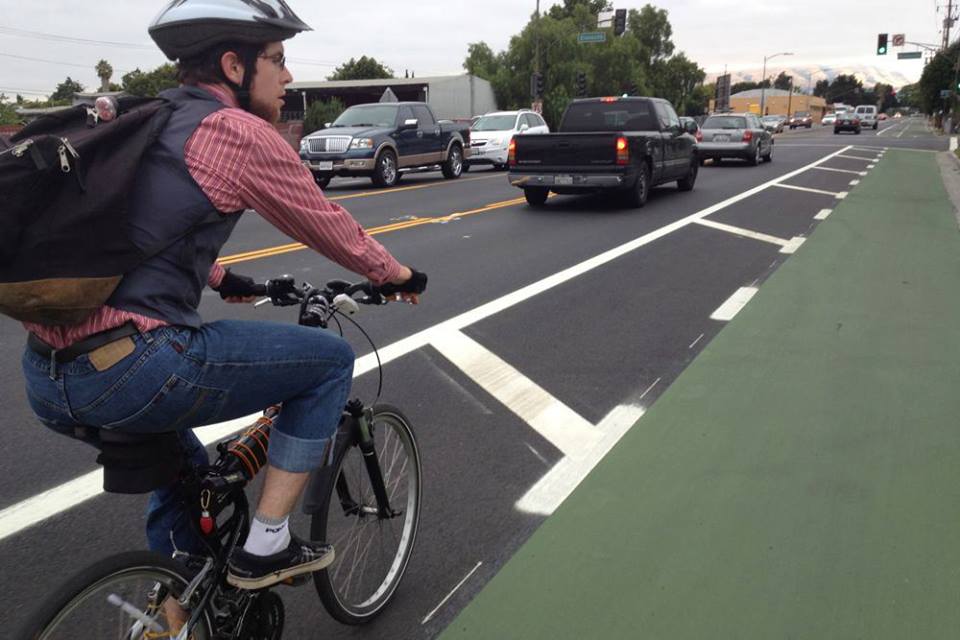
Photo courtesy of Lady Fleur (who also has an amazing bike blog).
Remember, while I may be a bicycle knight, my armor is only plastic and cotton. As a driver you sit behind the controls of a 4,000 pound death-sledge which hurtles down city streets at 40 miles and hour, which is roughly 160,000 pounds of force (F =ma), if I have the math right (I’m a political science major, not a physicist, we don’t learn real math or science). That is enough force to smash through walls, or flatten a cyclist or pedestrian. Remember that the next time you text while driving (only 6 times worse than driving drunk).
[EDIT]: A friend linked me to this rebuttal piece to the NY Times article I discuss above. It is pretty preachy and radical at times, but he makes a lot of good points and I am inclined to agree with him as much as the NY Times writer, perhaps more.
Last night I attended my first hackathon, one held in honor of the late Aaron Swartz. If you don’t know who Aaron is yet you should; he helped found Reddit and numerous other projects of note, as well as being very politically involved against SOPA and more. I wasn’t entirely sure what to expect as I took my Muni bus to the Internet Archive. The Archive was a beautiful old building, Greek columns and stained glass; I was in love.
I got there later than intended, thanks to my formerly mentioned bus running late, and missed the entire Hackathon portion of the event. This was fine for me, someone who doesn’t code anymore and hasn’t for years (C++ in highschool barely counts). I wanted to go for the speakers, specifically Cindy Cohn of the Electronic Frontier Foundation. Cindy was going to be talking about her work with the EFF reforming the Computer Fraud and Abuse Act, the poorly worded and archaic federal law used to drive Aaron to killing himself. Thanks to the dedicated efforts of the EFF, a couple members of Congress recently introduced “Aaron’s Law” to Congress, the first tangible attempt at reforming the CFAA.
Other speakers included Wired magazine investigations editor Kevin Poulsen, speaking about FOIA requests (specifically Aaron’s and MIT’s involvement in blocking its release). Public Domain advocate Carl Malamud spoke about his fight to make public building regulations actually available to the public. Brewster Kahle , the online activist and head librarian of the Internet Archive, spoke about the work Aaron did with the Archive and what they were continuing to do. The Archive is working to make everything possible publicly available in a digital form, currently distributing some 40 million books a month. Unfortunately a fire burned down a small part of the Archive last week, causing $600,000 in damage and making their job that much harder. While the Archive has received thousands of dollars of donations, they still need more, please donate if you can.
After an hour and a half of empowering and informative, sometimes personal and emotional, speeches the event was over. The hackathon continues all this weekend at Noisebridge in San Francisco and around the world. One does not need to be a hacker to participate, even this writer found a couple projects to get involved with (as expected and hoped for). If you don’t see this blog until months from now don’t despair, Noisebridge will be around and there will be more hackathons. There is always more work to do, rather than fret about missed opportunities use that energy to create new ones.
A brief bit of background on myself. I’ve grown up on the Internet, it has made me who I am. Even before the Internet, I had a home computer (a gift from a neighbor who worked for the school district), one of those huge bulky things from the 80s where the screen and computer were all one colossal box and the screen had only two colors, green and black. My parents got me my first Internet capable computer when I was twelve; that same year I discovered Everquest, the first MMORPG to get big years before WoW ever existed. I also was indoctrinated to the world of peer to peer sharing, back in the glory days of Napster before the lawsuit. I remember the creation of Bit Torrent, the revolutionary new way to transfer files in a fraction of the time that has now become the standard method to share, as Napster once was. I can also look back with fond amusement of my revulsion to Bit Torrent when I first learned of it, and confusion over the need of a torrent client. I was being forced outside my comfort zone and being forced to learn more, a welcomed opportunity now.
Let’s contemplate that last phrase, I was being forced to learn more by being forced outside my comfort zone and that is a good thing; why? When I was twelve I was much more resistant to change and much less knowledgeable about the world. The Internet is the evolutionary pressure that has helped that change to happen through exposure to various media, music and writings. Unfortunately, greedy corporations and the government are acting to subvert the transfer of media to the masses, like the RIAA back in the early 2000’s and JSTOR/the DoJ with Aaron Swartz. Musicians and other artists/professionals have a right to profit off their craft, that goes without saying, but a balance can be struck, a third way can be found (or fourth, fifth, n-th ways).
One example out of the many for a new model to emerge allowing artists and consumers to both win is the example of the mash up duo The Legion of Doom. After putting their first album, Incorporated, on their website for free download these DJs gained both fame and notoriety. Unfortunately, some of the artists who created the original songs that the Legion remixed wanted their songs removed and the album is no longer available on their website. Regardless, the Legion created a following by encouraging fans to share and through their use of P2P which allowed them to sell out a limited release of their CD in a very short time, self distributed without a label to take their profits. Two years later Radiohead took a similar approach with their album In Rainbows.
The Internet is the Democratization of knowledge perfected, and if knowledge is power that makes it an amazing institution to share power as well as knowledge among the masses. Sharing is a public good, with little private gain involved; you don’t make money off sharing a file for free on Napster. Arguably, extant educational fair use law allows individuals to download media for their own research to further a field of study. They do not need to be a profession or have a degree, there are no such requirements merely that the use of that media help you further some field of study. Interpret that however you will.
I’ve spent a lot of time talking about the Internet and how important it is, that is not meant to detract from how important the real world is. The Internet is the real world, there is no distinction between these two states of existence. It is dangerous even noxious to believe that there is a separation between the two, that kind of thinking leads to faux pas like when everyone saw Anthony Weiner’s wiener. For years I have lived by the rule that everything I posted online would be public knowledge. That is also how I plan to raise my children; before we even have the sex talk we will have the Internet talk where I tell them that nothing online is private ever. For this reason, among others relating to my practice of security culture, I was not terribly concerned by the NSA wiretap, though I was wholly pissed off. While it doesn’t surprise me that the NSA was spying on pretty much every person in the world other than the President (as far as he knows), it does still bother me that they feel they can use my name as an American to defend their unconstitutional actions. Instead of just getting pissed off and doing nothing but fume, I prefer to channel that anger into constructive things like being politically involved.
One great way to be political is to encourage your legislator to vote for Aaron’s Law and similar legislation to scale back the CFAA or to protect our rights online. Let them know you oppose legislation link SOPA, PIPA, ACTA, and CISPA which seek to undermine our freedoms online and our free access to information. Political activism isn’t a singular act; it is a habit. One does not become an activist by going to one protest, one becomes an activist by staying active and engaged in the political process. Another thing you can do is sign this online petition about Aaron’s Law; while online petitions mean next to nothing compared to a professional lobbyist they do still have an impact as Aaron showed us with his petition that helped stop SOPA. Online petitions should be considered as a tool in the activism toolkit used in conjunction with other more major tools like writing letters to the editor or political actions. It should be noted that few major political battles, if any, are won online alone.
I’m going to end with a quote of Aaron’s from his Guerilla Open Access Manifesto, “With enough of us, around the world, we’ll not just send a strong message opposing the privatization of knowledge — we’ll make it a thing of the past. Will you join us?” Will you? Will you stand up for your freedoms both online and off?
[EDIT]: If you haven’t seen the NSA files decoded you should check it out and thank the stars and stripes for Edward Snowden, a national hero. If you feel inspired to take more action sign on to the EFF’s demand to end mass surveillance.
This is my first posting of what I am calling photo-poems, one of my photos paired with a poem to create a mood. This poem is about those couples who cease to exist as a pair of distinct individuals and fully collapse into one another, becoming a singular entity.
Collapse
Like two stars colliding,
Smash, we are a supernova baby.
Crushed so tightly together,
We occupy the same space and break physics.
You glowed so brightly off alone,
Even the moon wanted to steal your shine.
It took my white dwarf smile,
To rekindle your red giant heart.
Like two stars colliding,
Smash, things are all wrong.
We were meant to be companion stars,
Instead we accrete eachother’s matter.
I take on you, you take on me.
A-Ha! We come one and merge.
But physics won’t allow us exceed
Our own mass potentials.
Like two stars colliding,
Smash, we are a supernova baby.
Gone, our days as companions are
No longer two, but a singular star.
But when stars go supernova
You’re not guaranteed a nurturing explosion,
Which sends positive energy into the universe,
Sometimes a hole is left, an ugly black hole.
Sometimes when stars go supernova baby,
A big black hole is left where the love once was.
Sometimes when people go supernova baby,
They collapse into one another like two colliding stars.
They merge, co-mingle, and co-habitate.
In time Scott and Mandy become Scandy,
In time you lose your identity.
But who needs that when they have “love”?
After so long there is nothing left but a black hole,
Sucking in all potential futures, leaving just one.
I’ve never felt so hopeless than when you made me into a nova,
But somehow I broke your gravity, and I am still riding that shockwave.
You may or may not have heard of Burning Man, growing up in the SF Bay Area I’ve known about it and suspected I would end up there since middle school. Most people think of Burning Man as a giant RAVE in the desert, like Coachella (only cheaper than Coachella and it lasts a week instead of four days). But Burning Man is so much more. You could spend all week out there and listen only to live music or at least not electronic, or even no music at all. There is a TEDx out there as well as the Palenque Norte lecture series and countless other talks and classes on nearly every topic you can think of. Simply put, there is something for everyone of all ages in that desert, from the very young to the very old.
There are art cars, vehicles of all sorts transformed into living art projects.
While music primarily is electronic there was still live music to be had, namely this badass drummer.
Along with music Burning Man is riddled with philosophy and thought provoking works of art.
Burning Man honors many American cultural landmarks…
And at the end of the week everything burns, even the Temple.
One thing I have learned from years of researching Burning Man it is that no one knows exactly how or why it was started, either that or people know and are unwilling to come to a consensus on the facts. This has left the event’s origin shrouded in rumor with an elaborate mythology. Stories range from the tragic death of a friend or pet, to an explosive divorce with an awful wife, to the mundane desire to just burn a man on the beach. I’ve developed my own theory about the roots of Burning Man, and choice of current location. I call it a theory but it is meant more as a humorous observation, rather than something taken with the weight of actual science, and it meant to be seen as inclusive (not mutually exclusive) with all other theories. You may call this the Dune Origin Myth for the starting of Burning Man.
If my first post didn’t make it clear I love Dune, the David Lynch movie not the book. I have not read the book yet, which I’ll admit is a failure on my part because books are awesome. In Dune, there are several planets, including Caladan and Arrakis; I will only be discussing these two as the only relevant ones to this post, as well as a small bit of the plot without spoiling anything. The main characters, the royal family of Duke Leto Atreides, live on Caladan, a planet covered in a vast ocean. They are instructed by the Emperor of the Known Universe to go to Arrakis to take control of the spice mining operations. Arrakis is also known as Dune, it is a dry desert planet where nothing grows and there is no life other than giant sandworms and the hardy Fremen people. The only thing of value on Dune is the spice Melange; this spice is vital to space travel and expands consciousness. Over years of using the spice people can evolve to be more than human, as is evidenced by the Spacing Guild navigators.
Now that you know the relevant literary context let me address how this applies to the founding of Burning Man. I was born in San Francisco, and the furthest I have ever lived from there is Santa Cruz; being a lifetime Bay Area resident the ocean is the salt in my blood. Burning Man was started by Bay Area residents, artists and crafters, as well as a fair few jolly pranksters, in my hometown of San Francisco. In a quick four years, it grew too big to be housed on Baker Beach in SF and they had to find somewhere new to burn a Man. They found the Black Rock Desert, a geographic feature known as a playa, which coincidentally is Spanish for beach. Burning Man had now found a beach big enough to hold countless many more free spirits and pleasure seekers.
Thanks to help from John Law of the now mostly-defunct SF Cacophony Society, the 1990 Burn was moved to the Black Rock desert, where the virgin BMORG effectively co-opted the Cacophony Society’s Zone Trip #4: A Bad Day at Black Rock making it the first Burning Man. I use the term co-opted rather lightly here, Larry Harvey and Jerry James were invited by John Law and Michael Mikel of Cacophony to come along to burn their Man. The co-opting happens in history where the event is solely remembered for being the first Burning Man in the Black Rock Desert, part of this posting is keeping the history of Cacophony alive in the wake of a dominant countercultural force like Burning Man. History is written by the conquerors, even the history of counterculture movements. I guess you could say I have a soft spot for Cacophony.
Like the Atreides family these brave adventurers embarked on a grand pilgrimage to a place they had never gone before, a place radically different than the world they were leaving behind. Duke Leto comforted his son with some sage advice before they set out for Dune, “A person needs new experiences … Without change something sleeps inside us and seldom awakens. The sleeper must awaken.” Larry Havery also recognized the vast potential for change out there in the desert, “I drew a line on the ground, and I said on the other side of this line everything will be different. And everything has been different.” On the other side of the line is a desert and deserted world, void of plants and animal life, a place of nothing but dust. In Dune the spice is said to be in everything on the planet, to permeate all life there, just like the dust in the Black Rock Desert saturates all things brought onto its alkaline expanse. While in Dune it was a spice-dust that expanded consciousness for us Burners in the Playa there isn’t anything spicy about it, though it is alkaline.
Despite Burning Man being a global phenomenon, according to 2011 census over half of Burners still came from California with over a third from Northern California. While we are beginning to see more participation from inland areas as Burner culture permeates deeper into humanity’s collective conscious, it remains primarily an activity of us coastdwellers. Like Arrakis in Dune, Burning Man exists as a context where ocean people, or put broader people that are not of the desert, can go to the desert and learn how to survive out there in its harsh and unique climate. Whether you go to Burning Man as a survivalist, you will leave the Burn as a survivalist. This event trains you to survive in one of the harshest environments out there, which for me is part of the appeal; testing my limits to further my personal growth. The great thing about the Burn is that there is something for everyone, no matter your age or personal background; nothing is forced on you and nearly anything is permitted that doesn’t violate relevant state or federal laws. It is a blank canvass for each individual to paint their masterwork, before burning it away and starting fresh.
For my first post permit me to humor my love of the movie Dune.
A Beginning Is A Very Delicate Time. Know then that my name is Mitchell Colbert and it is the year 2013. The Known Universe is ruled by a panoptic technology that is enmeshed in everything we do, called The Internet. In this time, cool kids write about what they do and post it on the Internet for complete strangers to read it, and maybe laugh, and perhaps expand their consciousness. The Internet is vital to modern life and available even during space travel.
Humanity, and a subspecies of Trolls who have been mutated by thousands of hours on /b/, use the Internet to read the news, watch funny cat videos, and post 140 character updates to Twitter. We can stay connected to any part of the universe without moving from our chairs.
I’m done paraphrasing Dune for now, but I felt it an appropriate way to start things off. Now that I have gotten the ball rolling permit me to tell you why I have decided to create this blog and join the ranks of those illustrious cool kids who tell people about what they do on the Internet.
This blog is not a political blog, it is not a photography blog, cooking blog, DIY blog, or any sort of themed blog, but it will probably include all those topics and more. This blog is about things that stir up my passions so much that I need to share them with the world. Expect political posts to keep you up to date on the news the networks don’t cover, expect me to share life hacks to make your life easy mode, and expect me to post plenty of recipes/photos/poems. I am a person who views knowledge as a communal good that should be shared with as many people as possible, this blog is my means to that end.
I will be trying to post with some regularity, once or twice a week. That may not always happen since, unlike professional bloggers, I don’t get paid to write this and work a real job, at the world’s largest medical cannabis dispensary, Harborside Health Center. You may now be wondering how much of a real job working at a medical cannabis collective actually is, read on, dear readers, and find out.
A beginning truly is a very delicate time, and how something begins can predict how well it will fair. I picked today











 Well Suited For Life